
In The Media
Press Release and Articles
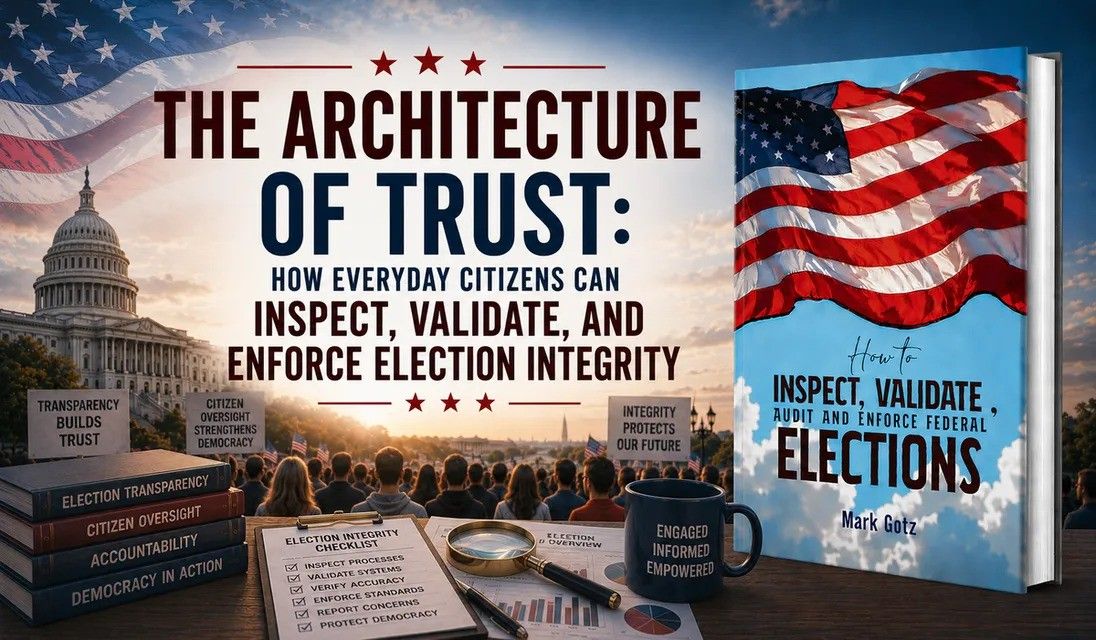
The Architecture of Trust: How Everyday Citizens Can Inspect, Validate, and Enforce Election Integrity
When Benjamin Franklin emerged from the final, cloistered session of the Constitutional Convention, a woman waiting in the Philadelphia streets demanded to know what kind of government the delegates had produced after four months of absolute secrecy. Franklin’s response was as much a warning as it was an answer: “A Republic, if you can keep it.”
For generations, Americans have largely treated the maintenance of that republic as a passive exercise. We cast our ballots in community centers and school gymnasiums, collect our “I Voted” stickers, and return to our daily lives, trusting that the vast, invisible machinery of the administrative state will accurately record the voice of the people. But trust is not a self-sustaining resource. It must be continually validated through transparency. In an era where the mechanics of our elections are increasingly decentralized, complex, and scrutinized, blind faith in the system is no longer sufficient.
Amazon: How to Inspect, Validate, Audit, and Enforce Federal Elections: An Educational Pamphlet for Citizens
Democracy does not run on autopilot. When the custodians of our election data fail to maintain the ledgers, or when the sheer volume of ballots overwhelms the traditional safeguards, the responsibility to inspect, validate, and enforce the law falls back to the original architects of the republic: the citizenry.
The Master Ledger: Purging the Phantom Voter
The foundation of any legitimate election is the voter roll. It is the master ledger of a community’s political will. Yet, despite its importance, this database is highly susceptible to decay. Voter rolls are living documents that fluctuate daily as citizens come of age, relocate, or pass away. When local officials neglect the meticulous maintenance required to keep these logs accurate, the system becomes burdened with ineligible addresses, duplicates, and deceased individuals. These “phantom registrations” create a fertile breeding ground for systemic discrepancies.
A citizen auditor’s first line of defense is examining the fundamental requirement of jurisdiction. To vote in a federal election, a citizen must reside within the precinct where their ballot is cast. A glaring vulnerability in modern voter rolls is the prevalence of non-residential addresses. By requesting a list of commercial properties from the local county appraiser—who legally separates residential and commercial parcels—citizens can cross-reference these locations against the voter registration logs. When active voters are discovered “residing” at shopping centers, big-box stores, or vacant lots, citizens have the actionable data needed to force a correction.
Equally problematic is the phenomenon of duplicate registrations, an issue unintentionally exacerbated by the National Voter Registration Act (NVRA) of 1993. Commonly known as the Motor Voter Act, this legislation mandated that social service agencies offer voter registration to individuals applying for government assistance. To protect the applicant’s privacy, the law requires that the specific office where the registration took place remains confidential. While well-intentioned, this privacy shield blinds the system. An individual applying for housing, food assistance, and healthcare at three different agencies could be registered three separate times, their identical information masked by the confidentiality clause. Catching these overlaps requires diligent civilian auditors to comb through the rolls, searching for identical birth dates and names—often catching slight variations like a middle initial or a nickname—that reveal a single person registered multiple times.
Finally, there is the grim but necessary task of identifying deceased voters. Election officials are expected to cross-reference their rolls with the National Change of Address database and mortality records from the Social Security Administration. However, bureaucratic backlogs frequently leave these individuals on the active ledger. When government agencies refuse to release mortality data to civilian oversight groups, citizens must use alternative methods, such as filtering the voter rolls for individuals over the age of one hundred and matching those names against county obituaries and probate records.
Auditing “Election Month”
There was a time when voting was confined to a single Tuesday in November, making civic observation a relatively straightforward endeavor. Today, with the widespread adoption of early voting and the explosion of mail-in ballots, Election Day has evolved into a sprawling “Election Month.” While this expansion is championed for its convenience, it inherently complicates the chain of custody.
The goal of auditing an election is not to determine who won, but to establish an independent, citizen-verified count of exactly how many votes were cast. When citizens know the true volume of participation, they possess an irrefutable mathematical baseline.
This begins at the physical polling locations. For early voting, which typically spans ten days, citizen groups can post volunteers outside centralized precincts to log every individual entering and exiting the building. By asking voters for the machine count at the end of the day, or securing it from cooperative election personnel, volunteers can build a precise daily tally.
Election Day requires a more strategic deployment of manpower. In a county with dozens of precincts, volunteers should blanket the largest locations and use demographic math to estimate the rest. Historically, federal elections yield roughly a 60 percent turnout. By multiplying the registered voters in an unmonitored precinct by that historical average, and subtracting the known volume of early and mail-in votes, auditors can project the expected Election Day turnout with remarkable accuracy. If the government’s final tally diverges from this observed count by more than a few percentage points, it is a glaring warning sign that warrants an immediate inquiry.
The Vote-By-Mail Blind Spot
If in-person voting is the bedrock of electoral security, the Vote-By-Mail (VBM) system is its most exposed flank. Ensuring the integrity of this system requires aggressive, daily tracking. In the thirty days leading up to an election, citizens must establish communication with the supervisor of elections to track exactly how many VBM ballots have been requested, mailed out, and returned.
But counting the envelopes is only the preliminary step; validating their authenticity is where the real battle for integrity occurs. This takes place at the canvassing board meetings.
Canvassing boards are tasked with reviewing mail-in ballots to ensure they meet basic legal requirements, the most critical of which is signature matching. It is imperative that citizen observers attend these public meetings. Observers must visually inspect the signature matches alongside the officials, comparing the signature on the envelope to the official state record. If an envelope lacks a signature, or if the handwriting wildly deviates from the file, citizens must vocalize challenges to prevent that ballot from entering the count.
Furthermore, observers must watch for the physical markers of ballot harvesting—the organized, bulk collection of absentee ballots by third-party operatives. A sudden influx of envelopes with no return addresses, batches bearing the exact same style of postage stamps, or stacks with no stamps at all are major red flags indicating that the ballots were not mailed individually, but deposited in bulk.
When drop boxes are utilized, the scrutiny must be heightened. Because these receptacles are often unmonitored, citizens can conduct their own daytime stakeouts, counting the vehicles that utilize the box. If a volunteer counts fifty cars utilizing a drop box, but election workers later retrieve five hundred ballots from that exact receptacle, the mathematical impossibility demands an immediate, formal request to segregate those ballots for an intensive validity review.
The Power of Pro Se Patriotism
When citizens do the grueling work of auditing the rolls and monitoring the canvassing boards, they often expect their findings to be met with administrative gratitude. Instead, they are frequently met with bureaucratic stonewalling. Officials cite policy, hide behind legal jargon, and attempt to run the clock out on the citizen’s patience.
Faced with this resistance, many Americans simply walk away, believing they lack the authority to force a government agency’s hand. This is a profound misunderstanding of federal law.
The National Voter Registration Act and the Help America Vote Act (HAVA) were written to empower the individual. Under the NVRA, the government is legally mandated to maintain accurate voter lists and to make all records concerning those maintenance programs available for public inspection. When officials refuse to comply, Section 11 of the NVRA grants citizens a “Private Right of Action.” If a citizen provides written notice of a violation and the state fails to cure it, that citizen has the absolute right to bring a civil action in federal court. HAVA expands this authority, allowing any person who believes a violation has occurred, or is about to occur, to file a formal complaint.
You do not need an expensive election attorney to exercise these rights. The legal system allows any citizen to file a lawsuit pro se—on behalf of themselves. Drafting a federal complaint requires four basic elements: identifying the parties involved, establishing the proper venue (your local U.S. District Court), clearly articulating the specific legal violation, and defining the relief sought, such as an injunction to clean the rolls or segregate unverified ballots.
Taking a government agency to federal court is undoubtedly daunting, but it is the ultimate expression of civic duty. Alexander Hamilton wrote in the very first Federalist Paper that it was left to the people of this country to decide whether societies of men are capable of establishing good government from reflection and choice. No elected official, government office, or partisan think tank has the capacity to single-handedly save our electoral system. The architecture of our trust was built by the people, and only the people can enforce its structural integrity.