
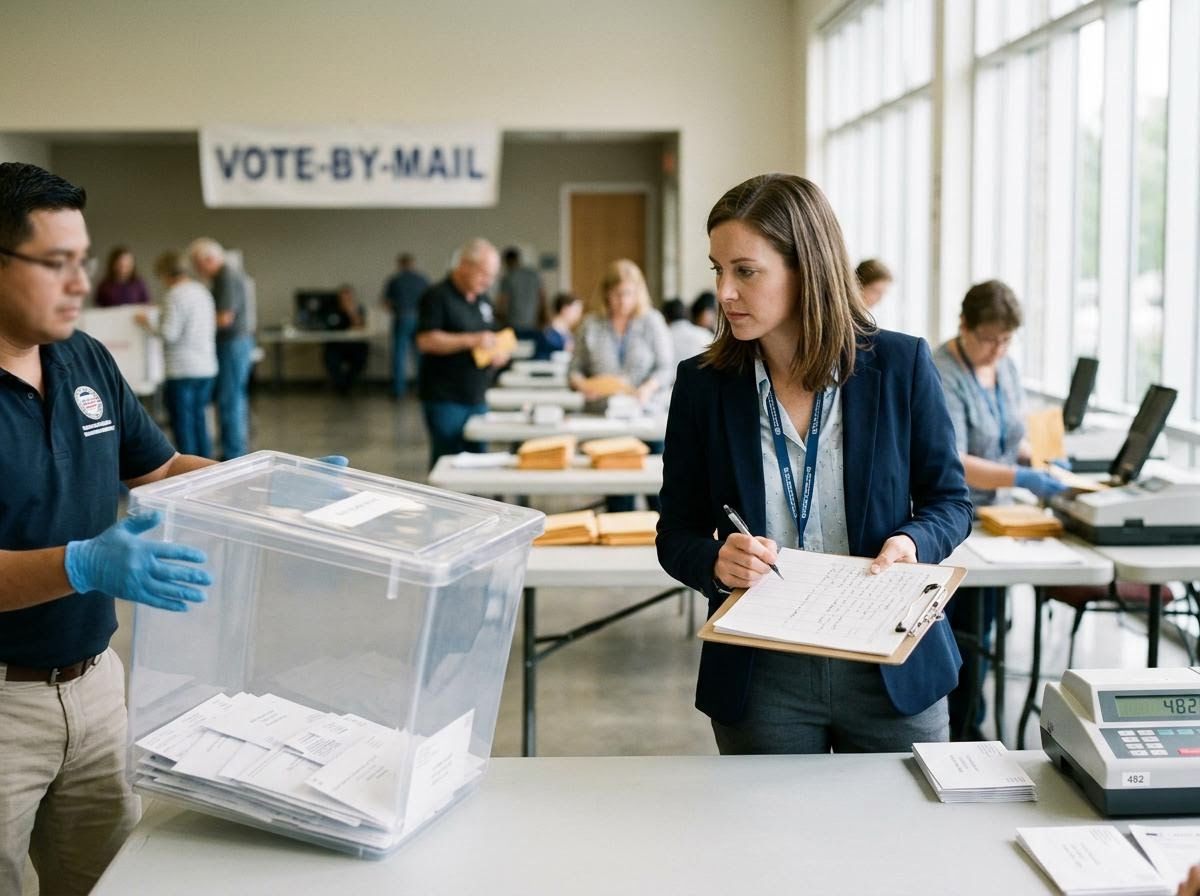
Based on the presentation by "The Election Experts," here is a summary of the election month process and the methods for identifying the total number of votes cast.
The presentation focuses on methods to monitor the election process and independently verify the total number of votes cast to ensure election integrity.
The Three Methods of Voting
There are three ways to vote, each with its own tracking process:
Early Voting: This typically takes place over a 10-day period before Election Day. Voters cast their ballots at designated early voting precincts.
Election Day Voting: This process is the same as early voting, but it happens at all precincts on the actual day of the election.
Vote-by-Mail (VBM): This is a 30-day process where ballots are sent to voters and returned via mail, drop box, or the election official's office.
How to Track and Verify In-Person Voting (Early and Election Day)
For both early voting and Election Day, the tracking process is similar:
Count the Voters: Observers should count the number of people who physically go into the polling place to vote. By doing this, you are counting the number of ballots cast.
Verify with the Clerk: At the end of each day, ask the precinct clerk for the total number of votes cast and compare it to your count.
Handle Discrepancies: The numbers should be close. If there is a large discrepancy (e.g., you counted 100,000 voters, but the official claims 125,000 ballots were cast), you must investigate the number of ballots issued and counted that day. By the end of early voting and Election Day, you should have the total number of votes cast in person.
How to Track and Verify Vote-by-Mail (VBM)
VBM requires more involved monitoring:
Establish the Baseline: Contact your county supervisor of elections or the state's chief election official to find out how many VBM ballots were requested and mailed out. According to the speaker, the National Voter Registration Act of 1993 (NVRA) and the Help America Vote Act of 2002 require these officials to create a public log of this information.
Track the Returns: VBM ballots are returned via the postal service, official drop-offs, or drop boxes. Ask your supervisor of elections every day for the number of VBM ballots received the previous day. By the Sunday before Election Day, you should know the total number of VBM ballots received during the 30-day period.
Act as an "Election Umpire": The speaker suggests acting as an "Election Umpire" to observe the validation of VBM ballots. This involves verifying that the front of the envelope has a postmark, a return address, and an official timestamp indicating when it was processed. Missing any of these could indicate an invalid ballot.
Check the Signatures: The back of the envelope must have a signature that matches the name on the front. Observers should watch as election officials match the signature on the envelope to the signature on file. The speaker states that envelopes without a matching signature are placed in a pile on the official's records.
Provisional Ballots and Late VBM
The speaker emphasizes that any VBM ballot received after the 30-day period or after Election Day should be treated as a provisional ballot.
Federal Law: According to Section 302 of the Help America Vote Act (HAVA), voters have the right to cast a provisional ballot if their name is missing from the registry or if an official challenges their eligibility. HAVA states that provisional ballots cast after Election Day should be set aside and given to a canvassing board for validation. The speaker notes that any state that does not follow this section of HAVA should not be allowed to certify its election.
Final Verification
By Election night, you should have a good estimate of the total votes cast by adding your tracked numbers for early voting, Election Day, and VBM. The speaker states that your calculated number should be within 1% of the official count declared by election officials. If there is a large discrepancy, such as a variance of 25,000 votes, this indicates a problem that requires legal action.